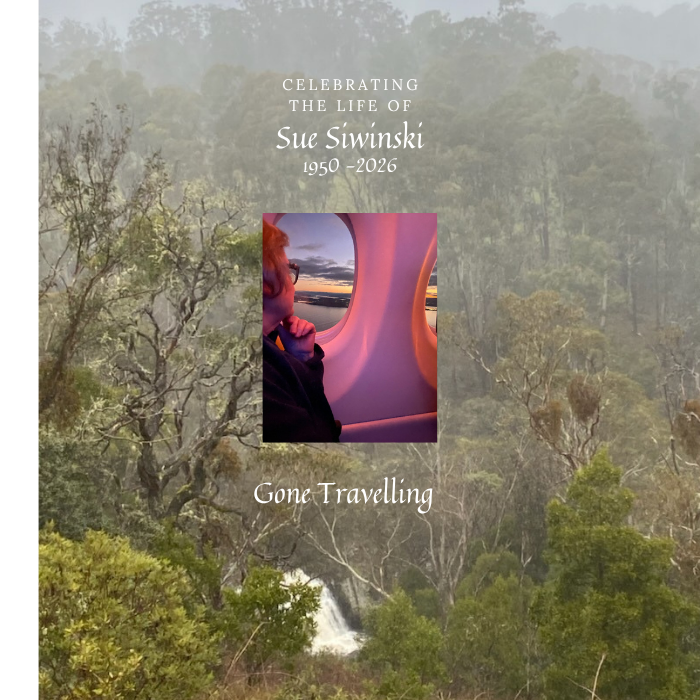
Farewell Sue!
Remembering Sue Siwinski
I had met with Sue at the hospital to plan her farewell ceremonies. She wanted her family to have a small, private service at the crematorium and then later, a public ceremony where her colleagues from Bishop Druitt College and the wider community could gather to remember her.
Unfortunately, I was away when the first ceremony was held, but a colleague bravely stepped in, and stepped up, to support the family. Together with Sue, I had planned that first gathering to be very different from a more formal funeral ceremony. Rather than following a tightly structured order of service, there was only a loose framework to hold the gathering, with plenty of space for family members to speak as memories arose and conversation unfolded — more like sitting together around the kitchen table, sharing stories about someone you love. Both the family and the celebrant were very happy with the outcome.
Last week, after returning from my time away, I had the privilege of hosting Sue’s public ceremony.
Here are a few excerpts.
“I met with Sue at the end of July to talk about this ceremony and how she wanted it to be. It was a privilege to spend that time with her, and to work with Sue and her family to create today’s ceremony.
Before we begin, I’d like to invite you to take a moment to bring Sue to mind. You might think of a particular story, something she taught you, a conversation you had, or how she cared for you. (Pause)
When Sue and I met, we didn’t spend much time talking about her illness or about death. We talked instead about her life — the things she had enjoyed, and the things that continued to interest her. A few themes came up repeatedly: her love of family, her excitement for learning and teaching, and her great interest in the natural world. We will hear now from Sue’s family, who will share the eulogy and some of their stories.”
Words of Remembrance
There are many different ways Sue will be remembered. For Ruth and Pok, she was Mum. And, as children often experience their mothers, that relationship changed over time. She could be frustrating as well as supportive, and always there. She loved Ruth and Nathan, Paul and Vicky, and she adored her granddaughter, Zoe.
She valued her siblings and extended family, her friendships, her neighbours from her earlier years at Tanban, and the wide community of colleagues and students that grew around her working life.
Those who knew Sue well will remember someone independent, thoughtful and determined to make her own choices. She was strong-willed and knew what she wanted. She was curious, enquiring and interested in the world, with a capacity to keep learning.
She was competent, organised and prepared, right to the end. There was usually a list, a spare umbrella, bandaids, a shopping bag, an inflatable coat hanger and probably something else that nobody else had thought of.
She will be remembered as an educator, a woman of the world, a lover of science, a good book and a woman with a plan.
Sue had many interests, many communities and many opinions. She was sometimes proper, sometimes unconventional and often an enigma, different things to different people. She was her own person through and through.
Sue will be greatly missed.
I sense that Sue’s legacy would be to remain curious, to keep learning, to pay attention to the world around you, and to consider, as Mary Oliver asks in the poem that was read at Sue’s cremation:
“What is it you plan to do with your one wild and precious life?”
Sue herself seemed to have answered that question in the way she lived. Over and over when we met, she told me that she had lived a rich and full life. That is one of the great gifts she leaves her family: alongside the sadness of missing her, there is the deep gratitude of knowing that Sue felt she had truly lived, that her life had been rich, full and meaningful.
For that, her family are deeply grateful.”